
Fractional Careers: A New Path for Executives
Leadership, Career Strategy, Fractional Work
Beyond the Next Job: The Fractionally Focused Career for Modern Executives
Most executives respond to career restlessness the same way: they open a search window, polish their resume, and start looking for a new employer. The logo at the top of the pay slip changes, but the underlying model stays the same. The Fractionally Focused philosophy offers a different path: treat your expertise as an asset, and recognize that traditional employment is only one of many ways to monetize it and create impact.
What It Means to Be Fractionally Focused
The Fractionally Focused philosophy starts with a simple shift: instead of asking, “Who will hire me next?” you ask, “How can my expertise create value in different ways, for different stakeholders, at different scales?” Being Fractionally Focused does not mean juggling a dozen side hustles or abandoning stability. It means intentionally designing a portfolio of roles and revenue streams that reflect your strengths, interests, and appetite for risk.
In practice, this might look like combining a fractional executive role with advisory retainers, project-based consulting, board service, or teaching. The common thread is that you become the platform. Companies, clients, and partners plug into your capabilities in ways that suit them and you, rather than you fitting yourself entirely inside one organization’s job description.
Your Expertise Is an Asset, Not Just Experience on a Resume
For many leaders, career conversations revolve around titles, years of experience, and industry tenure. Yet beneath those labels lies something far more powerful: a set of repeatable capabilities that reliably create outcomes. That is your true asset. It might be turning around underperforming business units, building high-trust sales organizations, scaling operations, or navigating complex stakeholder environments. Whatever it is, it has market value independent of any single employer.
When you treat your expertise as an asset, you start to ask different questions:
Who benefits most from the outcomes I know how to create?
How urgent and valuable are those outcomes to them?
In what formats could they access this expertise—advisory, execution, training, or leadership?
This asset-based mindset frees you from the idea that your value exists only inside a single company’s org chart. Instead, you begin to see yourself as a creator of outcomes across a broader market.
Employment Is Only One Way to Monetize Expertise
Traditional employment is familiar, and it offers real benefits: steady income, benefits, and a clear sense of belonging. But it is only one monetization model for your expertise. Executives who embrace Fractionally Focused thinking explore other vehicles, such as:
Fractional leadership roles, where you serve as a part-time CxO for multiple organizations
Advisory retainers, offering strategic guidance to founders or boards
Project-based consulting for specific transformations or initiatives
Equity-based roles with early-stage companies in exchange for concentrated expertise
Teaching, speaking, or writing that packages your knowledge for broader audiences
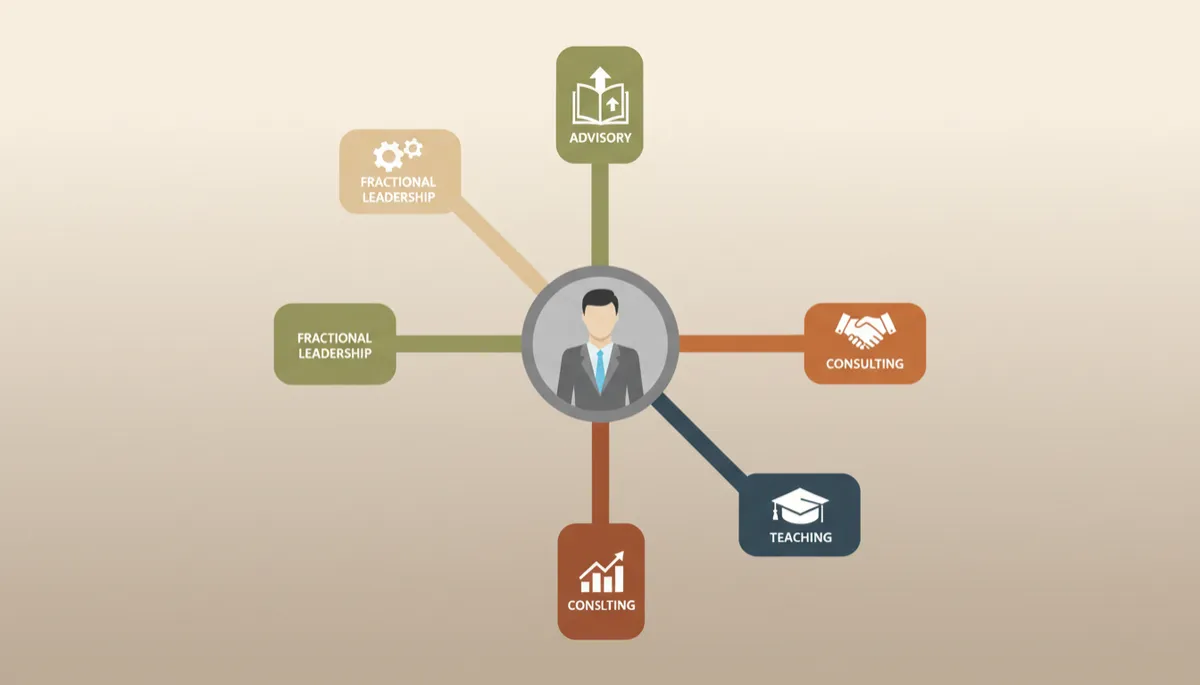
Diversifying how you monetize expertise can increase resilience and expand impact.
From Job Thinking to Revenue Model Thinking
Moving from “job thinking” to revenue model thinking is the core mental shift of a Fractionally Focused career. Job thinking asks: “What roles am I qualified for?” Revenue model thinking asks: “What forms of value can I create, and how do I structure access to that value?”
A useful exercise is to map your expertise into three layers:
Core outcomes you know how to deliver (for example: “reduce customer churn,” “launch new markets,” “stabilize operations”).
Formats in which you can deliver them (hands-on leadership, advisory, workshops, playbooks, or mentoring).
Revenue models that fit each format (salary, retainers, project fees, equity, royalties, or performance-based incentives).
Once you see these building blocks, you can begin to assemble a mix that fits your financial goals, lifestyle preferences, and appetite for experimentation. Employment may remain part of the mix, but it no longer has to be the entire picture.
Designing a Career with Multiple Sources of Value, Impact, and Opportunity
A Fractionally Focused career is intentionally portfolio-based. Instead of one role providing all your income, identity, and impact, you curate several complementary streams that reinforce each other. For example, insights from a fractional COO engagement might inform a playbook you teach to founders, which in turn elevates your profile and leads to board invitations or equity opportunities.
The benefits of this approach are significant:
Value: You capture more of the true market value of your expertise, rather than limiting it to one compensation band.
Impact: You work across industries, stages, and geographies, extending your influence and learning curve.
Opportunity: You are less vulnerable to a single company’s strategy or restructuring, and more open to serendipitous introductions and collaborations.
💡 Pro Tip: Start small. Add one new, low-risk revenue stream—such as a limited advisory engagement—before you redesign your entire career.
Taking Your First Fractionally Focused Step
You do not need to resign tomorrow to embrace the Fractionally Focused philosophy. Begin by clarifying the asset you already own—your expertise— and the outcomes it consistently delivers. Then, explore one additional way to monetize that asset alongside your current role. Over time, you can shape a career that is less about chasing the next employer and more about architecting a life of diversified value, deeper impact, and expanding opportunity.

SELECT BY SECTION
SORT BY STYLE